
Menu
The Impact of Redmond’s Rainy Season on Your Foundation
Concrete Foundation Repair Redmond
While Redmond’s rainy season provides a welcome source of water to the area, excessive moisture from rain can be detrimental to your home’s foundation and, therefore, requires careful management. When the ground becomes too wet, it may cause erosion, cracks, and structural issues in your home’s foundation. Therefore, as a homeowner, you should understand the potential hazards that excessive moisture can create for your home and take proactive steps to protect your home’s foundation so that your home remains stable for years to come and costly repairs are avoided. Whether your home sits adjacent to the Sammamish River or in a suburban neighborhood, protecting your home’s foundation will ensure that your home remains stable over time and costly foundation repairs are avoided. The purpose of this article is to examine how Redmond’s rainy season affects your home’s foundation and explain ways to protect your home.
Impact of Water On The Soil And Your Home’s Foundation In Redmond
Rainy seasons have an impact on Redmond’s clay-rich soils, as the water causes them to swell and apply pressure to the foundation. When this happens, it can result in cracks or shifting of the foundation, which can ultimately affect the foundation’s ability to remain stable. As the water swells and then contracts repeatedly, it will begin to weaken the foundation, increasing the likelihood of damage.
Poor drainage around your home increases the severity of the issue. It allows water to collect next to the foundation of your home, creating erosion of the soil that your home sits upon. Taking steps to understand how these dynamics work can help you to proactively protect your home from the effects of water on your foundation.
Heavy rain can create hydrostatic pressure that applies force to your foundation walls. Hydrostatic pressure can create cracks and, in extreme cases, bowing of the wall, which can severely compromise the structural integrity of your home. To prevent hydrostatic pressure and other problems caused by water, proper drainage and waterproofing need to be implemented.
Identifying Signs Of Damage
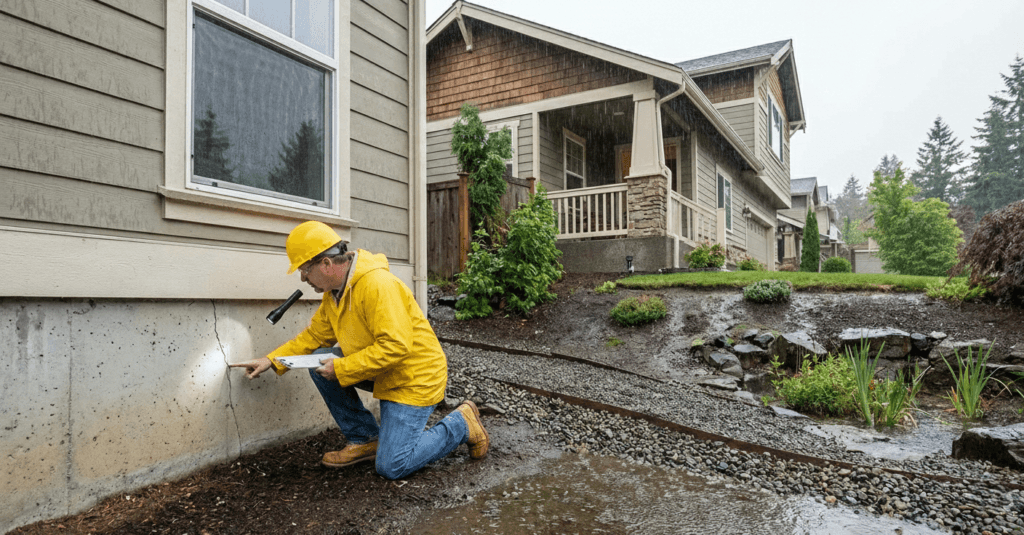
Early identification of potential damage to your home’s foundation is very important, and therefore identifying signs of potential damage is very important. Cracks in your walls, floors, or foundation are one sign of potential damage. Horizontal cracks or stair-step cracks in brickwork are especially dangerous and indicate potentially serious structural problems. Additionally, if doors or windows are sticking or not closing properly, it could be a sign that there is some kind of movement occurring within your home’s foundation.
When inspecting outside your home, look for signs of water pooling near the bottom of the foundation or gaps between the ground and your home. If you see any of these signs, contact a professional to inspect the extent of the damage. Identifying damage early will help you to avoid having to make larger and more costly repairs in the future.
Some additional signs of potential damage to your home’s foundation include uneven floors, gaps between walls and ceilings, and a chimney that leans away from the house. Address any of these issues immediately to stop the damage from getting worse.
Prevention
Preventing damage to your home’s foundation begins with good drainage. Make sure your gutter and downspout system directs water away from your home’s foundation. Also, extend your downspouts at least five feet from the side of your home so that water does not accumulate next to the base of your home. Clean your gutters regularly to avoid clogging that can cause overflows.
Also, grade the soil around your home so that it slopes away from the foundation. This will encourage the water to run off from your home instead of collecting and putting pressure on the foundation, and increase the chance of erosion. Installing a French drain or sump pump will also help to protect your home’s foundation from excessive amounts of water during heavy rains.
Because of the frequency of rain in Redmond, keeping your landscaping well-maintained is also important. Planting trees or shrubs that have deep root systems near your home can pull the water out of the soil and cause the soil to contract and your home to settle. Therefore, choose plants that have shallow root systems and plant them far enough away from your home’s foundation.
Repairing Damage
If your home’s foundation has already been damaged, repairs may be needed. Smaller cracks can typically be repaired by filling them with epoxy or polyurethane injection products that seal the crack and prevent water from entering. Larger and more severe damage, such as bowing walls or significant settlement of the foundation, may require underpinning or piering to stabilize the foundation.
Underpinning is when supports are installed underneath the foundation to stabilize it. Many types of supports can be used to underpin your home, including steel push piers, helical piers, and concrete piers. These methods provide long-lasting support to your foundation and help prevent future damage.
To determine what type of repair is best suited to your home’s specific needs, you should hire a qualified contractor who specializes in foundation repairs. Here at Redmond Concrete Works, our experienced contractors specialize in repairing foundations in Redmond’s climate. We want to ensure that your home remains structurally sound and safe for years to come.
Long Term Solutions
For long-term protection of your home’s foundation, consider applying a waterproofing sealant to the exterior walls of your home to prevent moisture from penetrating your home’s foundation. Installing a drainage system, like a French drain, will also help to remove excess water away from your home’s foundation.
Regular inspections are a great way to monitor the health of your home’s foundation. After every heavy rain event, inspect your home for signs of damage and repair any damage as soon as possible. By doing these things, you will be able to protect your home from the negative impacts of Redmond’s rainy season and ensure a stable home for years to come.
In addition to applying a waterproofing coating, you can also install a vapor barrier in your crawl space or basement. Vapor barriers help to prevent moisture from entering your home, which will eliminate the opportunity for mold and mildew to grow. Having a dry foundation is essential for maintaining a healthy living environment in your home.
LATEST POSTS